
Business today moves faster than ever before. Customers expect instant responses, smooth onboarding, and error-free service delivery. At the same time, companies are expected to reduce costs, increase efficiency, and scale without constantly increasing headcount.
This pressure has pushed businesses to rethink how they operate internally. One of the most important developments in this transformation is Business Process Automation, often shortened to BPA.
Business Process Automation refers to using technology to perform repetitive tasks and workflows with minimal human intervention. Instead of employees manually handling every step of a process, software systems execute tasks automatically based on predefined rules.
In industries that involve high levels of documentation and compliance such as bank account opening, automation is no longer optional. It is becoming a necessity for accuracy, speed, and regulatory compliance.
This article explains what business process automation is, why it matters, and how you can start implementing it effectively in your own business.
Understanding Business Process Automation
Business Process Automation is the use of technology to streamline and automate structured business activities.
These processes often include repetitive tasks such as data entry, document processing, approvals, notifications, and reporting.
Instead of relying on manual effort, BPA systems follow predefined workflows to complete tasks automatically.
For example, in a bank account opening process, automation can help collect customer information, verify documents, trigger compliance checks, and notify relevant teams without manual coordination at each step.
The goal of BPA is not to replace humans entirely, but to eliminate repetitive and time-consuming tasks so employees can focus on higher-value work.
Why Business Process Automation Is Becoming Essential
Modern businesses deal with increasing complexity. More customers, more regulations, and more internal processes create operational challenges.
Manual workflows are slow, inconsistent, and prone to human error.
Automation solves these problems by improving speed, accuracy, and scalability.
It ensures that processes are executed the same way every time, regardless of workload or employee availability.
In regulated industries such as financial services, bank account opening processes must follow strict compliance rules. Automation helps ensure that no required step is missed, reducing the risk of rejection or legal issues.
Key Benefits of Business Process Automation
One of the main benefits of BPA is improved efficiency. Tasks that once took hours can now be completed in seconds.
Another major benefit is accuracy. Automated systems reduce human errors in data entry and document handling.
Automation also improves consistency across teams and departments.
Scalability is another important advantage. Businesses can handle more work without significantly increasing staff.
Finally, automation improves customer experience by reducing delays in processes such as bank account opening and onboarding.
Common Areas Where Automation Is Used
Business process automation can be applied across many areas of a business.
In customer onboarding, automation helps collect and verify information quickly.
In finance, it can automate invoicing, payments, and reporting.
In HR, it supports recruitment, onboarding, and employee management.
In sales and marketing, automation handles lead capture, email campaigns, and follow-ups.
In compliance-heavy processes like bank account opening, automation ensures that all regulatory steps are completed correctly and consistently.
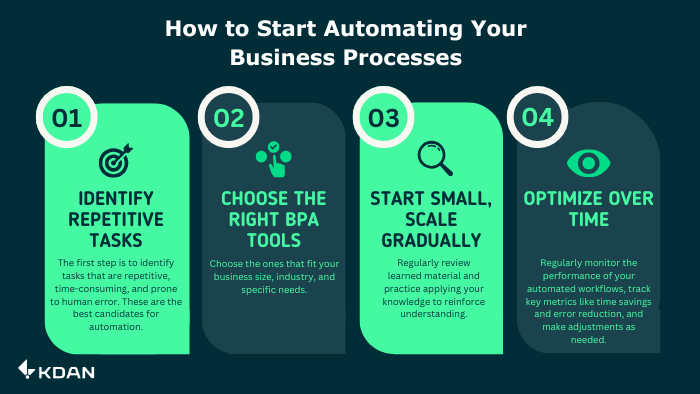
Step One: Identify Repetitive Processes
The first step in implementing automation is identifying repetitive tasks in your business.
These are tasks that follow a predictable pattern and do not require complex decision-making.
Examples include data entry, document collection, approval workflows, and status updates.
In a bank account opening workflow, repetitive tasks might include collecting identification documents, verifying customer details, and sending confirmation emails.
Once these processes are identified, they can be mapped for automation.
Step Two: Map Out the Workflow
Before automating anything, you must understand how the process currently works.
Workflow mapping involves breaking down each step in a process from start to finish.
This includes identifying who is responsible for each step, what inputs are required, and what outputs are produced.
For example, a bank account opening process might start with customer application submission, followed by document verification, compliance review, approval, and account activation.
Mapping ensures that nothing is overlooked when designing automation systems.
Step Three: Choose the Right Automation Tools
There are many tools available for business process automation.
Some tools focus on workflow automation, while others specialize in document management, customer relationship management, or communication.
The choice of tools depends on your business needs and complexity.
For example, a simple automation might use email and form integration tools, while more advanced systems might integrate multiple platforms for end-to-end automation.
For bank account opening processes, tools that support document verification, workflow tracking, and compliance monitoring are especially important.
Step Four: Start With Simple Automation
One of the biggest mistakes businesses make is trying to automate everything at once.
The best approach is to start small.
Begin with simple, low-risk processes that are repetitive and easy to standardize.
For example, automatically sending confirmation emails after a bank account opening application is received is a simple but effective starting point.
Once simple automations are successful, more complex workflows can be introduced gradually.
Step Five: Integrate Systems Across Departments
Automation becomes more powerful when systems are connected.
Instead of isolated tools, businesses should aim for integrated workflows.
For example, when a customer submits a bank account opening application, the data should automatically flow into CRM systems, compliance tools, and document storage platforms.
This reduces manual handoffs and improves efficiency.
Integration ensures that all departments work with the same real-time information.
Step Six: Add Approval and Compliance Rules
Many business processes require approvals before moving to the next stage.
Automation can be configured to include approval steps based on predefined rules.
For example, in a bank account opening process, compliance officers may need to review documents before approval is granted.
Automation ensures that these approvals are triggered automatically and tracked properly.
This improves accountability and reduces delays.
Step Seven: Test and Optimize Workflows
Once automation is implemented, it must be tested thoroughly.
Testing ensures that workflows function correctly and handle real-world scenarios.
Any errors or inefficiencies should be identified and corrected.
For example, if a bank account opening automation workflow fails to trigger document verification correctly, it must be adjusted before full deployment.
Continuous optimization ensures long-term success.
Step Eight: Train Employees on Automated Systems
Automation does not eliminate the need for employees.
Instead, it changes their roles.
Employees must be trained on how automated systems work and how to interact with them.
They should understand when to intervene, how to monitor workflows, and how to handle exceptions.
In processes like bank account opening, human oversight is still critical for compliance and decision-making.
Training ensures smooth adoption of automation systems.
Step Nine: Monitor Performance Regularly
Automation systems should be monitored continuously.
Key performance indicators such as processing time, error rates, and completion rates should be tracked.
Monitoring helps identify bottlenecks and areas for improvement.
For example, if bank account opening processes are still experiencing delays, the automation workflow may need adjustment.
Regular monitoring ensures that systems remain efficient and effective.
Step Ten: Scale Automation Across the Business
Once initial automation systems are successful, they can be expanded across the organization.
This includes more departments, more complex workflows, and deeper system integration.
Scaling automation allows businesses to handle growth without increasing operational complexity.
It also improves consistency across all processes.
Over time, automation becomes a core part of business infrastructure.
Common Mistakes in Business Process Automation
One common mistake is automating poorly designed processes. Automation cannot fix broken workflows.
Another mistake is overcomplicating automation systems, making them difficult to manage.
Some businesses also fail to involve employees in the design process, leading to resistance.
Lack of monitoring and optimization is another frequent issue.
Finally, ignoring compliance requirements in processes like bank account opening can lead to serious operational risks.
Avoiding these mistakes is essential for successful automation.
Why Automation Is Critical for Scaling Businesses
As businesses grow, manual processes become increasingly inefficient.
Automation allows companies to scale without proportionally increasing costs or headcount.
It improves speed, reduces errors, and enhances customer experience.
In regulated industries, automation ensures consistency and compliance in processes such as bank account opening.
Ultimately, businesses that adopt automation early gain a significant competitive advantage.
Conclusion
Business Process Automation is no longer a future concept. It is a current necessity for businesses that want to scale efficiently and operate competitively.
By automating repetitive tasks, businesses can improve accuracy, reduce costs, and enhance customer experience.
In critical workflows such as bank account opening, automation ensures compliance, speed, and consistency.
However, successful automation requires careful planning, proper implementation, and continuous optimization.
Businesses that adopt automation strategically will be better positioned for long-term growth and operational excellence.
FAQs
What is Business Process Automation?
Business Process Automation is the use of technology to perform repetitive business tasks automatically with minimal human involvement.
Why is Business Process Automation important?
It improves efficiency, reduces errors, lowers costs, and helps businesses scale more effectively.
How does automation help in bank account opening?
It ensures accurate document collection, faster verification, and compliance with regulatory requirements.
Do I need technical skills to implement automation?
Not always. Many modern automation tools are user-friendly and do not require coding skills.
What processes should be automated first?
Businesses should start with repetitive and structured processes such as data entry, notifications, and document handling.
Can automation replace employees?
No, automation supports employees by removing repetitive tasks but does not replace human judgment or decision-making.
How do I know if my business is ready for automation?
If your business has repetitive processes, delays, or inefficiencies, it is likely ready for automation.
You should also read: TechAiTech